The Worst Energy Retailers in Australia (For Supporters of Green Energy)
Originally published in 2021 with an update from 2026 noted below
Hello there my eco-conscious warriors 😊
In my last blog post I covered how the energy market works in Australia and why it’s impossible to have all of your energy supplied by green energy. For those of us on the national grid, our energy comes from a mixture of renewable and non-renewable resources so who you choose as your energy retailer does not change that fact.
But I also mentioned that who we choose as your retailer does matter because our choice of retailer can indirectly support the green energy market or the fossil fuel market, depending on who we go with. And there are some retailers that we should be avoiding if we want to avoid indirectly supportting the fossil fuel market.
The three energy retailers in Australia you would want to avoid are Energy Australia, AGL and Origin Energy. In my view, they are among the worst energy retailers in Australia if you’re looking for a retailer that supports the transition to renewable energy.
In this blog post I have put together information about each of these retailers and why they are not the best, if you are wanting to base your choice of retailer on the companies green energy credentials. This information was gathered in 2021 and was reviewed in 2026. I have left the blog post largely unchanged (except for a new table on the top 10 emitters) because a lot of the information is largley still relevant, however I did provide a 2026 update at the end of the blog post.
If you want to learn more, keep reading or click on what interests you below:
Note: I am not claiming they are the worst retailers by any other measure. Also saying they are THE WORST even with green coloured glasses is harsh – as you will read below, these companies are inevitably involved in the fossil fuel industry (guess someone has to be??) but they are taking steps to support renewable energy goals.
Still, they wouldn’t be the companies I would want my money to go to, for the reasons set down below.
Let’s get into it 🚀
What energy retailers should you avoid?
In my last blog post, I covered things to look out for when choosing a green energy retailer. Taking those points and flipping them, retailers that have these characteristics should be avoided:
- Those that own assets that generate energy from fossil fuels
- Those that do not offer carbon-neutral or GreenPower energy products
- Those that have policies and practices that encourage the consumption of energy
To determine which retailers to avoid, I focused on the first point – those that own assets that generate energy from fossil fuels.
I figure, if your profits are built on the consumption of fossil fuels, then how can you be a company that truly supports green energy?
And it turns out that Australia’s biggest emitters of greenhouse gases are also key companies in the energy retail market – namely AGL, Energy Australia and Origin Energy. This is evident based on the figures shows below (from 2019/2020 (diagram to the left)(1) and 2021/2022 (diagram to the right)(15)):
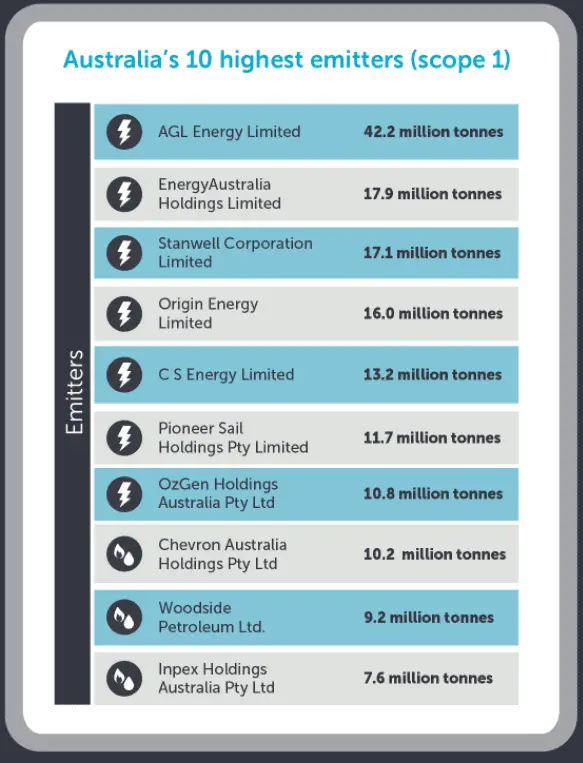
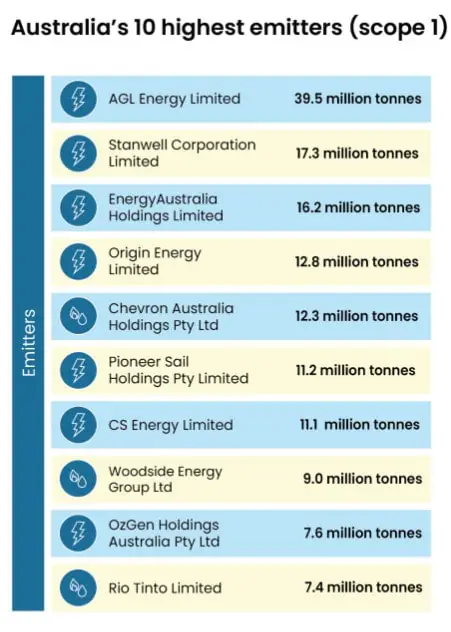
Scope 1 emissions “are direct greenhouse (GHG) emissions that occur from sources that are controlled or owned by an organisation” (3).
If you compare the two there has been some improvement but the point remains – AGL, Energy Australia and Origin Energy are not only energy retailers offering plans to household, but they are the largest generators of greehouse gas emissions in Australia.
So let’s get into where each of these companies stand on the issue of fossil fuels and greenhouse gas generation.
EnergyAustralia
EnergyAustralia released a climate change statement (September 2021) in which they set the following goals (10):
- “Reach net-zero greenhouse gas emissions by 2050…
- Reduce direct carbon dioxide emissions by over 60% on 2019-20 levels in 2028-2029…
- To transition out of coal assets by 2040…
- We will not build another coal-fired power station…
- We will create a net-zero transition plan and track our progress (including identifying pathways to zero Scope 1 greenhouse gas emissions by 2050).”
On a page explaining their position on reducing emissions, there are three points (7):
- “By investing in the next generation of technology that will meet customers’ energy needs, and offsets for remaining emissions, our goal is to be carbon neutral by 2050…
- Because we need reliable and affordable energy we’re investing to make our existing power stations more efficient…
- In 2014 weak wholesale energy markets led us to close a major coal-fired power station at Wallerawang in regional New South Wales… closing the plant meant we reduced the annual carbon emissions from our generation portfolio by about 5 mega-tonnes of CO2 – the equivalent of planting 35 million trees per year…”
In a paper issued in July 2018 (9) they stated:
“Compared to coal and gas, renewable electricity is intermittent, meaning it is less reliable and harder to control as the sun doesn’t always shine and the wind doesn’t always blow. Renewable electricity is one piece of the energy puzzle – but more pieces, such as energy storage, are needed to deal with intermittency. The challenge is that some of these technologies remain more expensive than historic forms of generation.”
They operate 3 power stations and one mine. They have partial ownership of one wind farm and power purchase agreements with 11 small-scale renewable energy farms (9). They have increased their investments in hydroelectricity and batteries in recent times.
They offer carbon-neutral products to retail customers, operating under the Australian Government’s Climate Active Carbon Neutral Standard.
My opinion: They really don’t want to tackle climate change – that was the impression I walked away with.
Yes, they recently issued a policy on climate change, but before this year (2021) they had no position on this, other than the commitment to being carbon neutral by 2050, with no pathway or blueprint that showed how they would reach that goal.
Their position on being net-zero by 2050 is built on the premise that they will continue to emit greenhouse gases, but the emissions will be net-zero because of carbon offsets.
The recent policy shift is not bad, but it doesn’t go far enough. For sure, it has not happened soon enough.
Their biggest accomplishment in reducing emissions was a forced closure of a coal-fired plant – not a deliberate decision on the company’s part, but one that was forced by a lack of demand.
Origin Energy
Since 2015 Origin Energy has been part of the “We Mean Business” coalition (12), focused on reporting on commitments to reduce greenhouse gas emissions (11).
They issue detailed sustainability reports each year. In the latest (2021) report, the following is noted (14):
- “An exit from coal-fired generation by 2032…
- Supply with renewables, firmed by large-scale batteries, gas-fired peaking generation and pumped hydro…
- Since 2016, we have committed to purchase the offtake from around 1,200 MW of new wind and solar projects across Victoria, Queensland and South Australia…
- Focusing on opportunities in renewable hydrogen and renewable ammonia made using renewable energy and sustainably sourced water.”
- “Our fleet of gas-fired power stations will continue to play a vital role in supporting the increasing supply from renewables across the grid as, unlike coal, they can be switched on and off quickly and operated efficiently on an intermittent basis….”
- “We offer solar energy, renewable and carbon offset products and EV solutions, and work with our customers to develop and deliver cleaner energy solutions.”
- “We have been giving our customers the option to choose renewable energy products for more than 20 years (they offer GreenPower products)…
- “We have long advocated for clear government policies to support Australia’s transition to a low-carbon economy and help make the transition easier for customers…”
This strategy is summarised as follows (14):
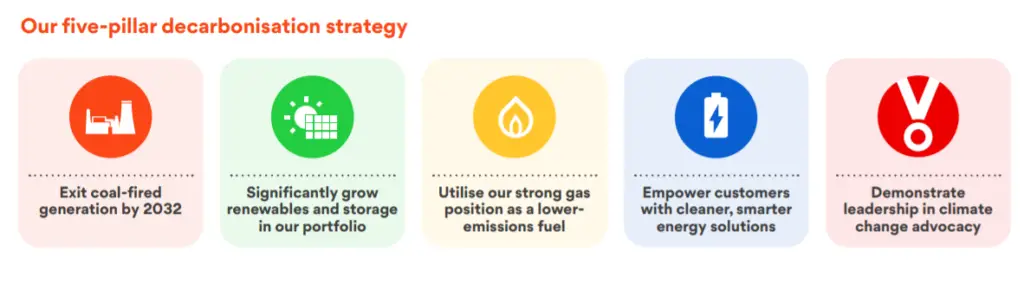
On their website they have summarised key actions taken towards sustainability as follows:
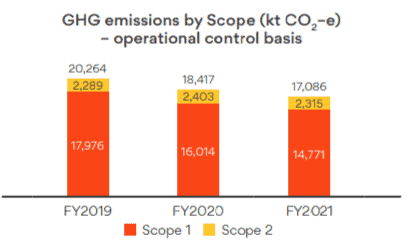
- “Scope 1 and Scope 2 equity emissions down by 8% compared to FY2020…
- Progressing the update of our emissions reduction targets to a 1.5°C pathway…
- Installed 74 MW of residential and business solar installations, up from 61 MW in FY2020…
- Launched Origin 360 EV Fleet, the first full-service EV fleet management solution of its kind in Australia”
Here is a visual of the reduction of greenhouse gas emissions over the last three years (14):
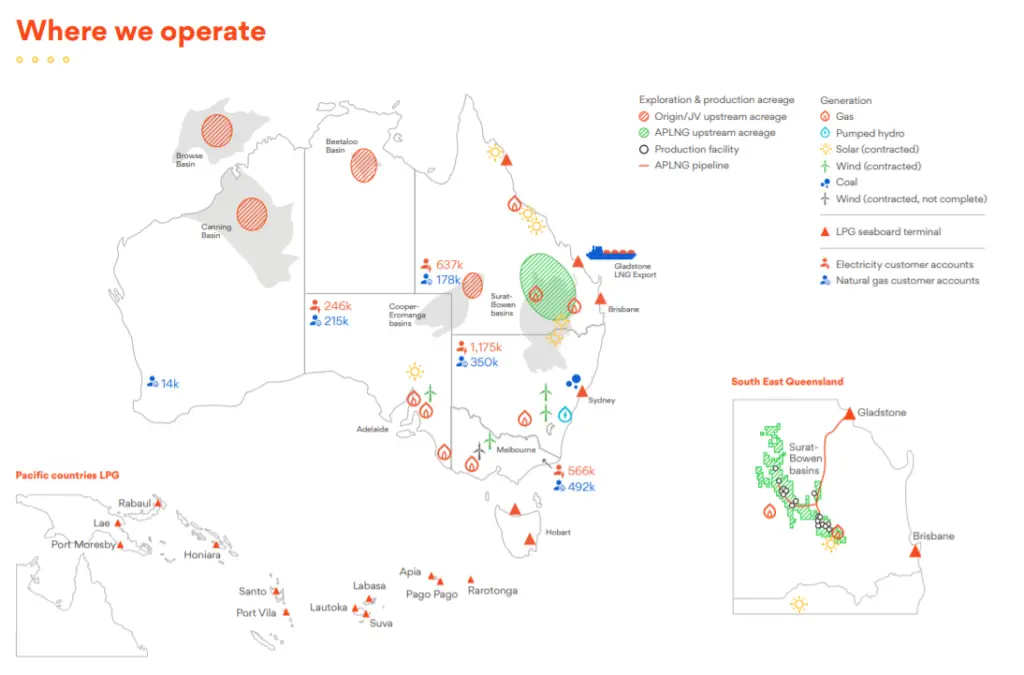
Their operations are heavily focused on gas, as noted below (14):
My opinion: They go further than Energy Australia in that they have set goals since 2015 and have taken a position that actively focuses on reducing greenhouse gas emissions.
However, the reduction over time is not substantial. And I think it’s easy to take the position they have regarding coal since they aren’t heavily invested in coal power generation, with only one coal power plant in their asset mix – their main investment is gas.
And gas is not a renewable energy source (see more below).
Origin sees gas playing an important role in helping to reduce greenhouse gas emissions. There are a lot more gas generation points in the diagram above compared to solar and wind, and I think the balance is not right.
I would not want to be supporting a company that is heavily invested in the gas market.
AGL
AGL has stated the following commitments in its Greenhouse Gas Policy issued in April 2015 (4):
- AGL will not build, finance or acquire new conventional coal-fired power stations in Australia
- By 2050, AGL will close all existing coal-fired power stations in its portfolio
- AGL will continue to invest in new renewable and near-zero emission technologies
- AGL will make available innovative and cost-effective solutions for our customers such as distributed renewable generation, battery storage, and demand management solutions.
- AGL will continue to be an advocate for effective long-term government policy to reduce Australia’s emissions in a manner that is consistent with the long-term interests of consumers and investors
On their website, they state:
“By 2050, we believe that Australia has the opportunity to be carbon neutral and an energy superpower…”
This will be realised by Australia generating low-cost power using zero-emissions wind and solar resources, backed up by technologies like batteries, hydropower and, for much of this transition, gas (5).
They stated the following commitments in 2020 (6):
- “Offer customers the option of carbon-neutral prices across all our products…
- Support the evolution of Australia’s voluntary carbon markets…
- Continue investing in new sources of electricity supply…
- Responsibly transition our energy portfolio…
- Be transparent.”
A pathway towards zero emissions is mapped as follows (6):

AGL is Australia’s largest private owner and operator of renewable energy assets – they operate 2 solar power plants, 6 wind farms and 1 hydroelectricity plant.
AGL also currently owns 8 coal power plants, 2 coal seam gas supplies, 2 gas storage stations and one overseas LNG import source.
A visual of their current asset ownership and where they want to be heading is shown below (6):

My opinion: Like Origin Energy, I think it’s great that they have taken a position since 2015 to reduce their greenhouse gas emissions.
But also, like Origin Energy, their operations rely heavily on gas operations. I’m sure gas has its place in a future market (maybe), but the level of investment and the position taken by these companies is not something I can support.
Gas is the solution?
I wasn’t going to go into this because it’s a bigger topic, but it should be pointed out as some don’t realise – gas is also a fossil fuel.
It’s often argued that it is “clean” because when you burn gas it produces 50% less CO2 than burning other fossil fuels. However, the real damage happens when gas is extracted (true for any fossil fuel), and some of the most significant impacts occur when gas leaks happen.
Natural gas is made up primarily of methane and methane is a much more potent greenhouse gas than CO2. So, in effect, gas is still a fossil fuel and can have significant climate impacts.
Here are some websites with information on this:
- Origin Energy – Natural Gas
- ABC Radio National – Is gas really clean energy?
- The New York Times – Is Natural Gas Clean?
- Climate Reality Project – Natural Gas Is a Fossil Fuel
Final remarks…
After reading a couple of reports and trawling through their websites, I can’t say I am an expert on the three companies mentioned.
I am sure I have probably misread, misunderstood and plain missed many things. My opinions are formed by gaining a general sense of the companies’ operations by reading what is publicly available.
Perhaps I am off in some parts, but on the whole, I am comfortable with my conclusions.
My conclusion is this – EnergyAustralia was slow to come to the table. They had a chance in 2015 when the Paris Accord was signed, but they stuck with the same position as the Australian government and only recently took a position on reducing greenhouse gas emissions.
AGL and Origin have done much better, but they are not as heavily invested in coal as they rely on gas. They are unwilling to let go of that.
I don’t think any of these companies have made any measurable gains in their greenhouse gas reduction targets since 2015, and that says a lot.
2026 Update
A lot has changed since I originally wrote this article in 2021. All three companies have made significant changes to their energy strategies, including increased investment in renewable energy and battery storage and clearer plans to retire coal-fired generation. However, all three still have significant fossil-fuel interests. I’ve left the original article largely intact because it reflects what I found at the time, but I’ve added some notes below on what has changed.
Energy Australia
Energy Australia’s current strategy includes (16):
- the 350 MW Wooreen battery in Victoria
- the 300 MW Tallawarra B gas/hydrogen peaking plant
- the proposed Lake Lyell pumped hydro project
- investment in the Kidston pumped hydro project
- batteries at Darlington Point/Riverina
- solar and battery packages for customers.
Also they have committed to closing Yallourn in mid-2028. The company says this will reduce its carbon emissions by around 60% relative to today.
EnergyAustralia still operates Mt Piper, a 1,430 MW black-coal power station in NSW, with an expected closure by 2040. Yallourn is 1,480 MW and is scheduled for mid-2028.
Overall, they have made considerably more progress towards transitioning away from coal than it had when I wrote in 2021, but it remains heavily invested in fossil-fuel generation, particularly coal and gas.
Origin Energy
Origin has made a much more substantial shift towards renewables and batteries.
In 2021, Origin was planning to exit coal by 2032. Then they annouced their Eraring coal-fired power station would be closed earlier, with the original plan being August 2025. These plans however have been delayed.
Nevertheless, Origin is taking further positive steps by building a huge battery at Eraring. The first stage is 460 MW / 1,070 MWh, and Origin has subsequently approved another 700 MWh stage. The combined project is expected to reach around 700 MW / 2,800 MWh.
So the company is essentially transforming its enormous coal-generation site into a major storage hub (17).
Origin still has its Australia Pacific LNG business and therefore remains heavily involved in the gas industry. Its FY26 results still describes Integrated Gas as a major part of the business (18).
AGL
AGL now plans to close (19):
- Bayswater by 2033
- Loy Yang A by the end of FY2035
The company has been investing heavily in:
- large-scale batteries
- solar
- wind
- grid-scale storage
- other firming technologies.
It still operates major coal-fired generation and has gas interests. Its coal plants will remain operating for years.
And its 2025 emissions data shows that its Scope 3 emissions associated with customers’ electricity and gas consumption remain substantial, although they have generally declined in several categories since FY21.
So there has been some progress for all three companies. Is it enough for me to support them with my business? Not really. I prefer the smaller retailers. I don’t loose out in terms of how much it costs me, so for me this is a very easy decision to make. And I do believe that these small actions matter because it is through these conscious choices we can collectively work towards a more sustainable future 🌎
xxx Tahsin
References
(1) Clean Energy Regulator – 2019–20 published data highlights
(2) Clean Energy Regulator – Australia’s highest 10 greenhouse gas emitters factsheet
(3) EPA – Scope 1 and Scope 2 inventory guidance
(4) AGL – Greenhouse Gas Policy
(5) AGL – Our approach to the environment
(6) AGL – Climate statement and commitments 2020
(7) EnergyAustralia – Reducing our emissions
(8) EnergyAustralia – HSSE Policy
(9) EnergyAustralia – Clean Energy Fact Sheet
(10) EnergyAustralia – Climate Change Statement, September 2021
(11) Origin Energy – Carbon commitments
(12) We Mean Business Coalition – About
(13) Origin Energy – Sustainability reports
(14) Origin Energy – Sustainability Report 2021
(16) https://www.energyaustralia.com.au/about-us/who-we-are/our-strategy
(18) https://www.originenergy.com.au/about/sustainability/